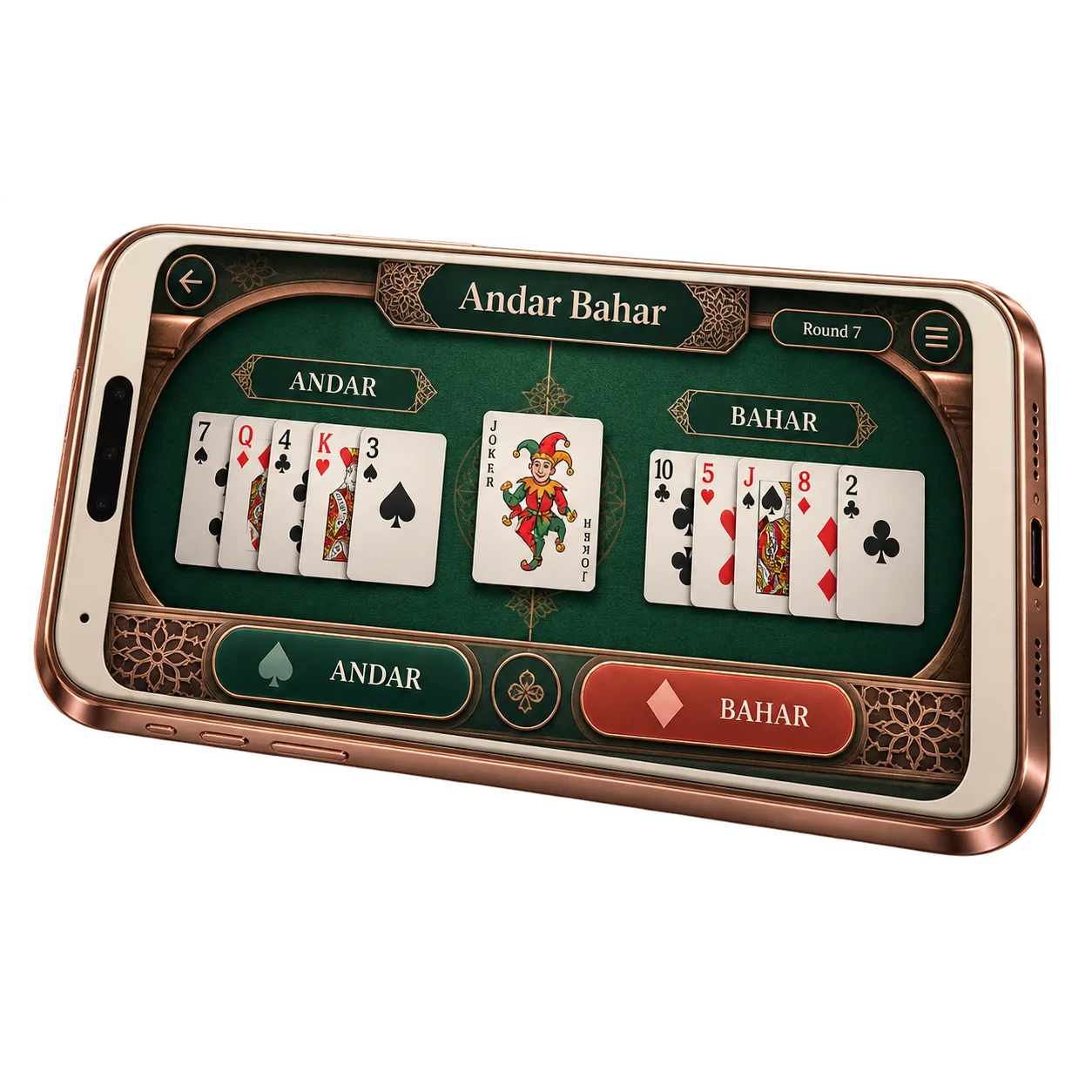
A single card is turned face up. Then cards go down alternately, one to Andar, one to Bahar, until one of them matches it. You picked a side before any of that happened, and the interesting part is that the two sides are not equal.
18+ only. Andar Bahar is a betting game. Play with money you can afford to lose.
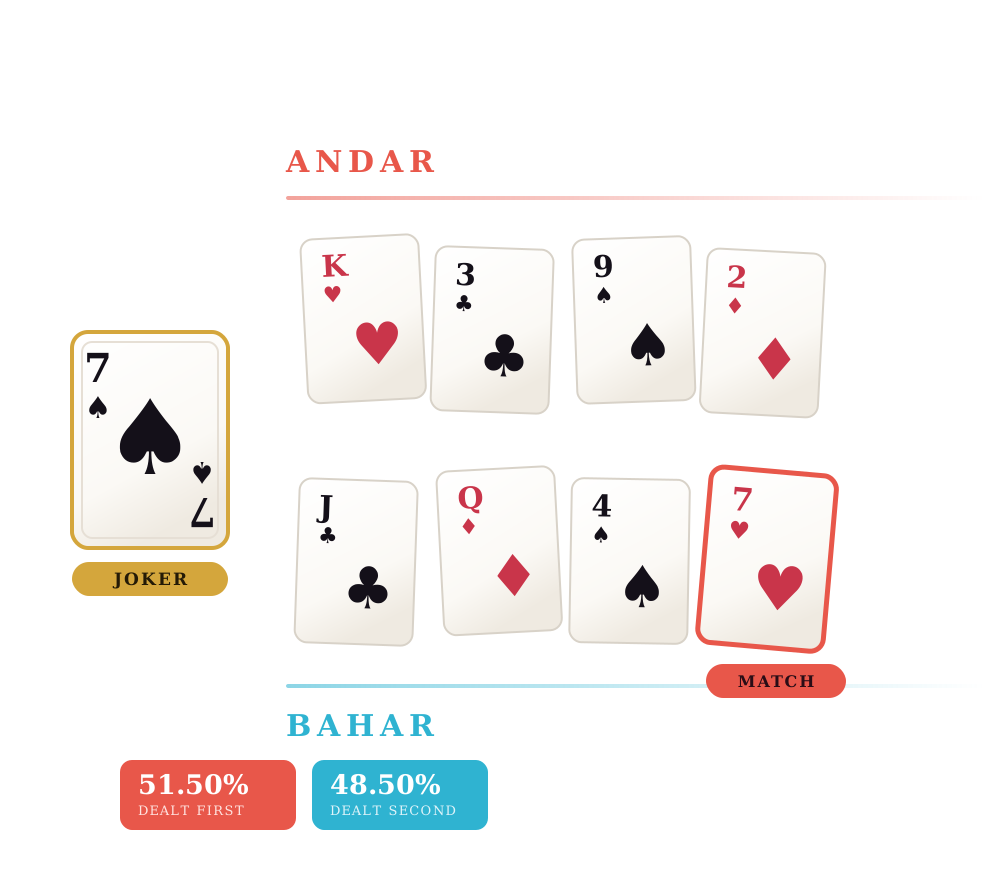
The side that receives the first card wins slightly more than half the time. That gap is fixed by the deck, not by the operator, and it is why the two sides are almost never paid the same.
Andar
In Hindi, andar means inside. On the table it is the first of the two rows, usually laid to the dealer's left, and in most rule sets it receives the first card whenever the joker is a black card.
Whichever side goes first carries the small advantage, because the match can land on its very first card and end the hand before the other side has been dealt anything at all.
Bahar
Bahar means outside. It is the second row, and it takes the first card when the joker is red. The naming is the whole vocabulary of the game: there is nothing else to learn.
The side going second wins a fraction less often, which is exactly why it is usually offered at the better price. The table is balancing the two against each other.
The deal
One deck, one joker, and then cards until something matches. There is no decision to make once it starts.
Andar or Bahar, before anything is dealt. That is the only decision in the game.
One card face up in the middle. Its rank is the target. Its suit colour decides which side receives the first card.
One to the starting side, one to the other, back and forth, all face up.
The moment a card appears with the same rank as the joker, the side it landed on wins. Everything stops there.
A hand, dealt out
The joker is the seven of spades, so the rank to match is a seven. Cards go down one by one and nothing matches until the sixth, the seven of hearts. Whichever side that card landed on takes the hand, and the four cards before it were simply the wait.
Most hands are decided in the first fifteen or so cards, but there is no ceiling. A joker whose three remaining matches all sit deep in the deck can run forty cards or more before anything lands.
The numbers
This is the whole edge of the game, and it comes out of the deck rather than out of the operator.
After the joker is turned, fifty one cards remain and exactly three of them share its rank. The hand ends on whichever of those three appears first. So the question is simply this: is that first match sitting in an odd position in the remaining deck, or an even one?
Odd positions go to the side dealt first. Even positions go to the other side. Count every arrangement of fifty one cards with three matches among them and the answer falls out cleanly.
Fifty one cards, three of them matching. The split is a property of the deck and no shuffle changes it.
An operator cannot pay both sides the same, because one of them wins more. So the first side is usually offered at a shorter price and the second at even money. Put those together with the percentages above and you get the real cost of each bet.
That is a narrow margin by the standards of the category, and it is the honest reason Andar Bahar is worth understanding: the game itself is close to even. What is not close to even is the pace, because a hand can finish in seconds and the next one starts immediately.
Check the payout your table is offering before you sit. If both sides are quoted at exactly the same price, the house is taking more than it needs to, and if the first side is quoted worse than 0.9 the same is true.
Length
There is no card limit. The hand ends when a match appears, and that can be the first card or the forty ninth.
Three matching cards sit somewhere among the fifty one that follow the joker. The hand ends on whichever of them turns up first, so the length of a hand is really the question of how deep the shallowest of those three cards is buried.
On average it is the thirteenth card. That is not a rule of thumb, it falls out of the arithmetic exactly: with three cards spread randomly through fifty one, the first of them sits at position fifty two divided by four.
Half of all hands are over inside ten cards, which is why an online table can run so many of them in a session. That pace is the part worth planning around. A margin of two or three paise in the rupee is small on one hand and considerable across two hundred of them, and two hundred hands is an ordinary evening at this speed.
If you want a single practical habit from this page, it is to decide how many hands you are playing before you start, not how much time you are spending. Time disappears at this pace. A hand count does not.
Online
Two genuinely different products share the name, and the difference changes what you are trusting.
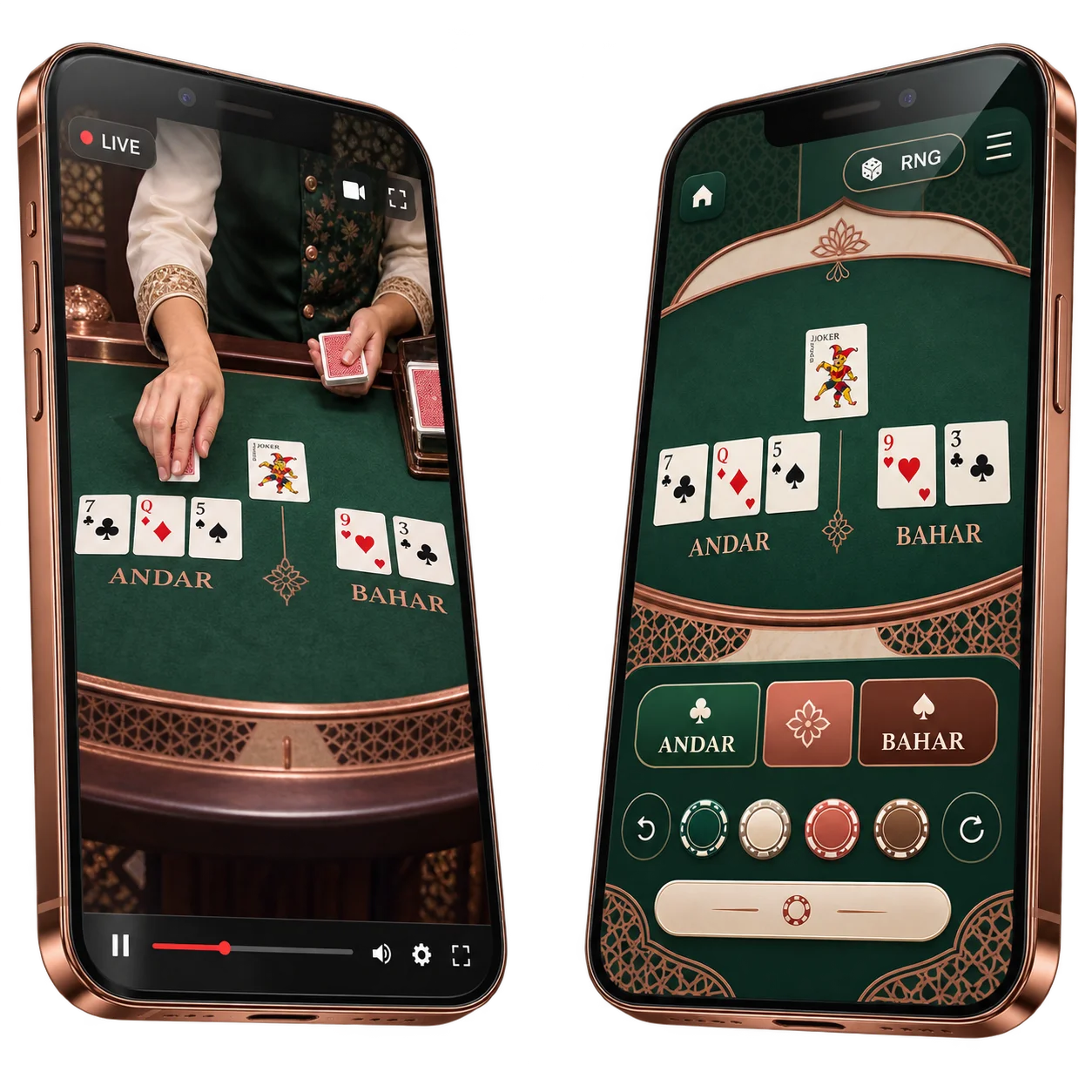
A live dealer table streams a real person dealing real cards from a real shoe, usually from a studio. You see the joker turned and the cards land in real time. Hands run slower because a human is dealing, and there is a betting window that closes before the deal starts.
A software table generates the result from a random number generator and animates the cards afterwards. It is faster, it is available at any hour, and the outcome exists before the animation begins. Neither is dishonest. They ask you to trust different things: one a camera, the other an operator's generator and whoever tested it.
If you are new to online Andar Bahar, the live tables are the better place to start, purely because the slower pace gives you time to see what is happening. Once you know the game, the software tables are the ones with the wider stake range and the shorter waits.
What does not change between them is the split. Fifty one cards, three matches, 51.5 against 48.5. A live table cannot deal a friendlier deck and a software table cannot tune one, so compare them on the payout and the pace rather than on which feels fairer.
Real cash
The cards behave identically. Everything around them does not.
Every app carries a practice mode running on demo chips with the same deck, the same joker rule and the same payouts. It is genuinely useful and it is genuinely limited: it teaches you the interface and the pace, and it can teach you nothing else, because there is no system for it to reveal.
Moving to real cash changes four things, and none of them are about the game.
In demo mode the number is meaningless, so people click the biggest one. With real money on it, the size of the stake against your total is the only lever you actually control.
A margin applies per hand. Demo play has no cost, so the speed is harmless. Real play at the same speed compounds the margin two hundred times an evening.
Deposits are instant and automated. Withdrawals are reviewed, and a first one triggers identity verification. That is normal. An operator going quiet once a payout is requested is not.
Online gaming winnings in India are subject to tax deducted at source, applied by the operator at withdrawal. What lands in your bank is smaller than the balance you asked to withdraw, so budget for it in advance.
A sensible way in is to play the demo until the interface is boring, then fund the smallest amount the app accepts, play a few hands and withdraw. You will have tested the one thing that actually distinguishes operators, and you will have done it for the price of a few rupees rather than a month of them.
Origins
Andar Bahar is not a casino invention. It arrived in the casino from somewhere much older.
The game comes from southern India and is most closely associated with Bangalore, where it has been played socially for well over a century. It travels under several names: Katti in parts of Karnataka, Mangatha or Ullae Veliyae in Tamil, and simply Andar Bahar across most of the north once it spread.
Its structure explains the survival. There is nothing to learn, nothing to remember and no equipment beyond a deck, so it works at a festival table with players of any age and any level of interest. The whole game fits in one sentence, which is rare and is why it moved so easily onto a screen.
The version you meet in an app is the same game with two additions: a payout that differs between the sides, and a set of optional side bets that did not exist at the family table. Both came from the casino, not from the tradition.
Mistakes
None of these are exotic. All of them are common enough to be worth naming.
The panel showing the last twenty results is a record. Every hand starts from a fresh shuffle and a new joker, so nothing in that panel has any bearing on the next hand. Backing a side because it is "due" and backing it because it is "running" are opposite beliefs and both are wrong.
The extras cost several times what the main bet costs. The larger number on the screen is the price of the bet, not a description of its value.
A stake that is 2% of your balance and one that is 20% of it are different games. The second one ends in a handful of hands regardless of how the cards fall.
Doubling to recover runs into two walls at once: your balance and the table maximum. The sequence needs an unbroken run of wins to work and the cards do not owe you one.
This is the quiet one. A table paying both sides at evens costs noticeably more than one pricing them properly, and it takes ten seconds in the rule panel to tell the difference.
Side bets
Most tables offer bets beyond the two sides: how many cards it takes to find the match, or whether the joker falls in a particular range. They advertise much larger multiples.
They are also where the margin actually lives. A main bet costing two or three paise in the rupee sits alongside side bets costing ten or more. If you take one thing from this page, take that the cheap bet is the boring one.
Streaks
Every hand starts with a full shuffled deck and a fresh joker. Six Andars in a row does not make Bahar more likely, and it does not make a seventh Andar more likely either.
Those are the two beliefs people bring to the table, they contradict each other, and they are wrong for the same reason. The road map on the screen records what happened. It cannot predict what has not.
The app
Andar Bahar apps are not carried by the Play Store in India, so the install runs through an APK. Normal for the category, and also where the risk sits.
That permission list is the quickest way to recognise a repackaged build. Nothing in a card game needs your contacts, your photos or your SMS, so an installer asking for them is not this app.
Note the gap between the two minimums. You can fund an account with ₹30, but ₹30 cannot leave it. Know the withdrawal floor before you deposit rather than after.
Version 1.1.1 · 34.3 MB · Android 5.0 or later · 18+ only
Questions
What do andar and bahar mean?
Inside and outside. They are the names of the two rows of cards, and that is the whole vocabulary of the game. You are backing one row against the other.
Which side should I bet on?
The side dealt first wins 51.5% of hands, but it is normally paid less for exactly that reason, so the two work out within a paise or so of each other. Pick either and pick the table with the better price rather than the better feeling.
How does the joker decide who goes first?
By its colour. In the most common rule set a black joker sends the first card to Andar and a red one sends it to Bahar. Some tables always start on the same side, so check the rule panel before you sit.
How long can a hand last?
Until a matching rank appears, which has no fixed limit. Most hands resolve inside the first fifteen cards or so, but a deal where all three matching cards sit deep in the deck can run far longer.
Is there a strategy or a pattern to follow?
No. Each hand uses a freshly shuffled deck and a new joker, so nothing carries over. The road map records history and cannot forecast. The only real levers are which side offers the better price and how much you stake.
Are the side bets worth taking?
They cost considerably more than the main bet. The two side wagers are among the cheapest bets you will find in this category, and the extras alongside them are among the more expensive. The larger multiple is what you pay for, not what you gain.
Can I play Andar Bahar online for free?
Most apps carry a demo mode on fake credit with the same deck and rules. It is the right place to learn the interface and the pace. It cannot pay out, and there is no system for it to reveal.
Is real money play available where I am?
That depends on your state, and the rules are not uniform across India. Check what applies where you are before depositing, and treat any site that tells you not to worry about it as a warning.
What is the difference between live and online Andar Bahar?
A live table streams a real dealer handling real cards. A software table draws the result from a random number generator and animates it afterwards. The odds are identical in both. Live is slower and easier to follow, software is faster with a wider stake range.
How many cards does a hand usually take?
Thirteen on average, and just under half of all hands finish inside ten cards. The longest a hand can run is forty nine, which happens when all three matching cards sit at the very bottom of the deck.
Where does the game come from?
Southern India, most closely associated with Bangalore, where it has been played socially for well over a century. It is also known as Katti in Karnataka and as Mangatha or Ullae Veliyae in Tamil.
Why do I see it spelled andar bhar?
A typing slip that has become common enough to be a search in its own right. Andar bhar, andhar bahar and a few other variants all point at the same game. The spelling changes nothing about the deck or the odds.